

Sentiment Analysis in Marketing Analytics: A Comprehensive Guide
Introduction
In an era where brands compete for attention across an ever-expanding array of digital channels, understanding not only what customers do, but how they feel, has become a strategic imperative. Traditional marketing analytics have excelled at capturing quantitative metrics—click-through rates, conversion percentages, session durations—but these figures only tell part of the story. Sentiment analysis, a discipline rooted in natural language processing (NLP), uncovers the emotional undercurrents behind customer conversations. By fusing sentiment analysis with conventional analytics, marketers gain a nuanced, real-time perspective on audience attitudes, enabling them to tailor messaging, nip emerging issues in the bud, and ultimately drive superior ROI.
This comprehensive guide explores the end-to-end process of embedding sentiment analysis into your existing marketing analytics framework. You will learn how to identify relevant data sources, select appropriate tools, implement best practices, mitigate common pitfalls, and measure impact using industry-recognized KPIs. Along the way, we cite authoritative research from sources such as Pew Research Center and the U.S. National Institute of Standards and Technology to ensure that your approach rests on a solid foundation of credible information.
Defining Sentiment Analysis
Sentiment analysis, sometimes called opinion mining, refers to the computational techniques that classify and quantify subjective information in text. At its core, it assigns polarity labels—positive, negative, or neutral—to short passages of text, such as social media posts, product reviews, survey responses, or customer service transcripts. More advanced systems go beyond basic polarity to detect emotion categories (joy, anger, sadness), intensity scores, and even sarcasm indicators.
Why is this important? Quantitative metrics can tell you that an email campaign generated a 25% open rate, but they cannot convey whether recipients felt delighted, frustrated, or indifferent. Sentiment scores transform raw text into actionable data points, bridging the gap between numerical performance indicators and the qualitative insights that inform messaging strategy.
The Role of Sentiment Analysis in Marketing Analytics
- Uncover hidden performance gaps. A product launch might drive record-high website traffic, yet sentiment analysis could reveal widespread dissatisfaction around a feature omission.
- Trigger proactive alerts. Sudden spikes in negative sentiment—such as complaints about service outages—can automatically generate notifications that help your team respond before an issue spirals.
- Enhance personalization. Understanding the emotional tone of individual customers enables more empathetic outreach—for instance, serving supportive content to users expressing frustration.
- Improve data-driven storytelling. Sentiment metrics enrich dashboards and executive reports, making it easier to explain not only what happened, but also why it resonated (or failed to resonate) with your audience.
By layering sentiment data on top of traditional KPIs, you create a fuller narrative of customer behavior and sentiment—empowering stakeholders to make decisions backed by both quantitative and qualitative evidence.
Data Sources for Sentiment Analysis
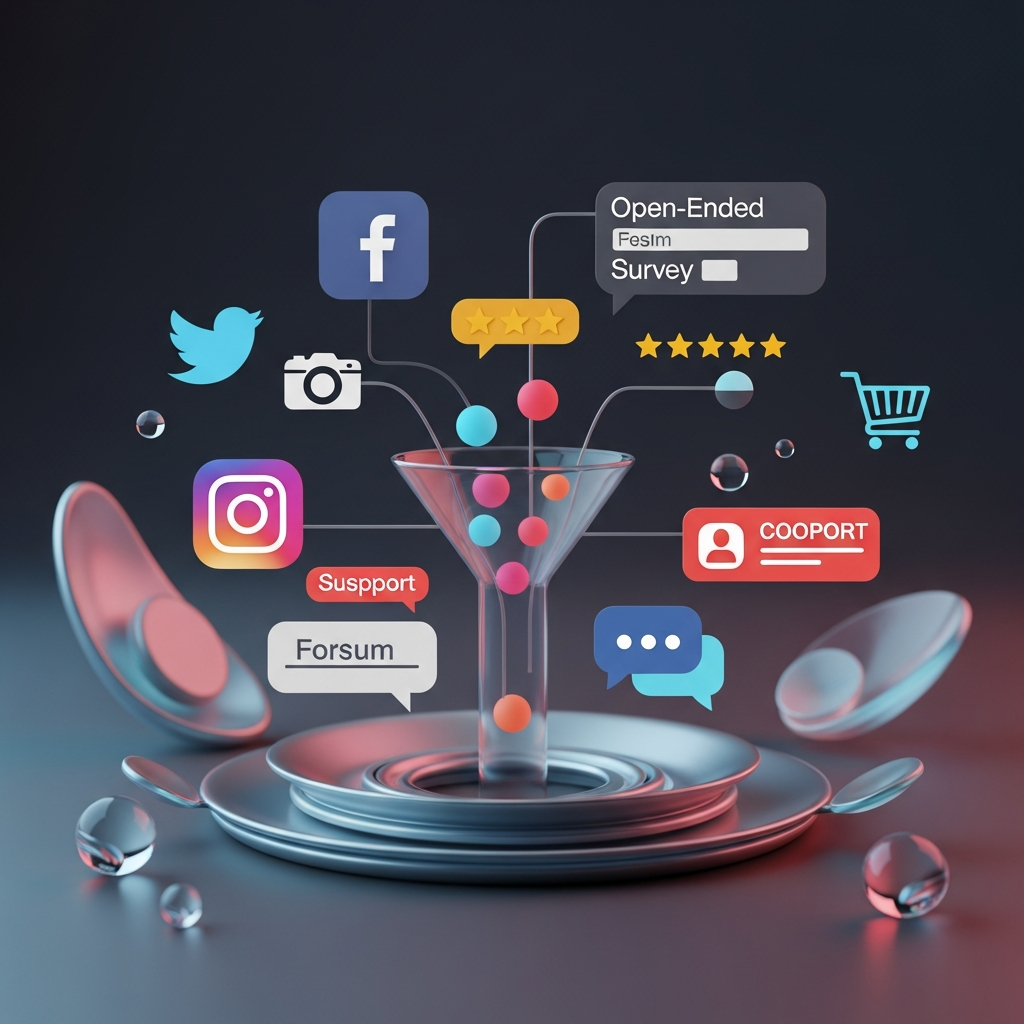
A robust sentiment strategy draws on a diverse set of data inputs. Each source contributes a unique slice of the customer journey, and aggregating across channels while cleansing for spam, duplicates, and irrelevant noise is vital to maintain high-quality input for sentiment scoring.
- Social Media: Platforms like Twitter, Facebook, and Instagram host candid, real-time brand conversations. Tools like the Twitter API or Facebook Graph API allow for scalable data extraction.
- E-commerce Reviews: Online marketplaces (Amazon, eBay) and direct retailers collect first-hand product feedback rich in customer experience details.
- Customer Surveys: Open-ended survey questions reveal unfiltered opinions. Services such as SurveyMonkey or Qualtrics support custom text analytics integration.
- Support Tickets and Chat Logs: Interactions logged in systems like Zendesk or Salesforce Service Cloud expose detailed pain points and resolution paths.
- Forums and Blogs: Niche communities (Reddit, brand forums) provide in-depth discussions that may not surface elsewhere.
Maintaining data quality through deduplication, spam filtering, and relevance checks ensures your models learn from accurate, representative samples of customer feedback.
Integrating Sentiment Analysis into Your Analytics Workflow
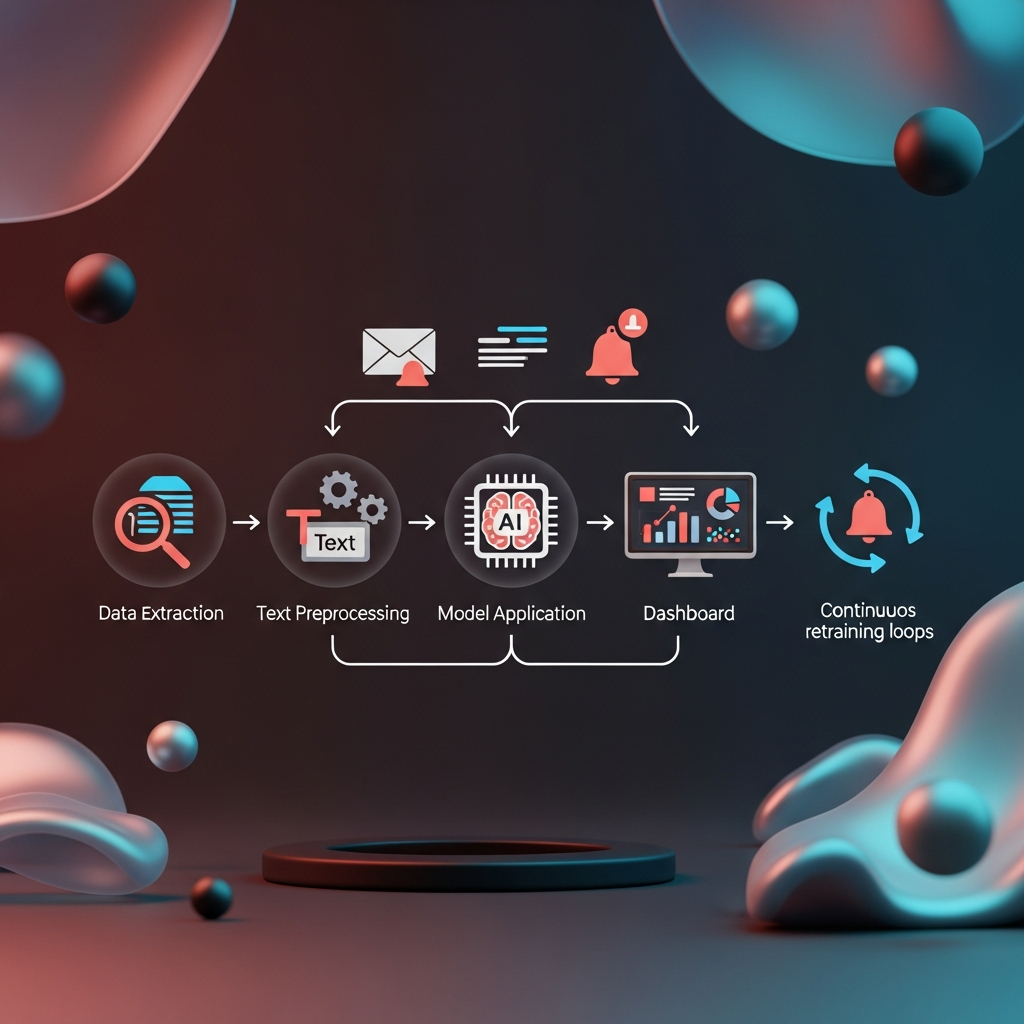
Embedding sentiment analysis requires a structured, repeatable process. Follow these six steps to align your technical setup with your business objectives.
Step 1 – Define Clear Objectives
Align sentiment analysis goals with business outcomes. Are you aiming to improve brand perception, reduce churn, or boost upsell rates? Establish measurable targets—for example, “Reduce net negative sentiment by 20% over six months” or “Increase average sentiment score for loyalty program feedback by 0.5 on a 5-point scale.” Document these objectives and share them with cross-functional teams to ensure consistent understanding.
Step 2 – Collect and Preprocess Data
- Extraction: Use ETL (extract, transform, load) pipelines to pull text from APIs or databases.
- Cleaning: Remove HTML tags, stop words, URLs, and irrelevant mentions. Leverage libraries like Apache Lucene or NLTK for tokenization and lemmatization.
- Normalization: Convert all text to lowercase, standardize emoticons, and expand contractions (e.g., “don’t” → “do not”).
Step 3 – Apply Sentiment Models
Choose between pre-trained APIs and custom machine learning solutions:
- Pre-trained APIs: AWS Comprehend, Google Cloud Natural Language API, Azure Text Analytics.
- Open-source libraries: VADER, TextBlob, Stanford CoreNLP.
For domain-specific accuracy, fine-tune transformer-based models (e.g., BERT, RoBERTa) on your proprietary data using frameworks like Hugging Face’s Transformers.
Step 4 – Enrich Analytics Dashboards
Integrate sentiment metrics alongside KPIs in BI tools such as Tableau, Power BI, Looker, or Google Data Studio. Common visualizations include time series of sentiment scores, word clouds of frequent negative terms, and geographic heat maps of regional sentiment variations.
Step 5 – Configure Alerts and Thresholds
- Email or Slack alerts when negative sentiment exceeds a predefined threshold.
- Incident creation in ticketing systems (ServiceNow, Jira) for critical issues.
- Daily or weekly sentiment summaries delivered to stakeholders.
Step 6 – Test, Evaluate, and Iterate
- Evaluate Model Accuracy: Measure precision, recall, and F1 scores using a labeled validation set.
- Human-in-the-Loop Reviews: Sample edge cases and ambiguous texts for manual annotation.
- Continuous Retraining: Refresh models quarterly to accommodate new vocabulary, campaigns, and slang.
Selecting the Right Tools and Platforms
When evaluating sentiment analysis solutions, consider the following criteria:
- Data Volume: High-volume enterprises may prefer scalable cloud APIs, while smaller teams can rely on open-source libraries.
- Customization Needs: Organizations requiring fine-grained emotion categories or industry jargon support should invest in custom model training.
- Budget Constraints: Open-source tools incur no licensing fees but demand engineering resources.
- Ecosystem Integration: For businesses on AWS, GCP, or Azure, leverage native services to minimize integration friction.
Refer to independent benchmarks such as those published by NIST for performance comparisons across models and languages.
Best Practices for Effective Sentiment Analysis
- Domain-Specific Training: Enhance accuracy on brand-specific terms, product names, and technical jargon by fine-tuning models with your own labeled data.
- Multi-Language and Dialect Support: Ensure your pipeline handles language detection and routes text to appropriate models for Spanish, Chinese, Arabic, etc.
- Hybrid Approaches: Augment machine learning with rule-based sentiment dictionaries to catch sarcasm, idioms, and slang.
- Data Governance: Define source approval, privacy guidelines, and data retention policies in compliance with GDPR and CCPA.
- Cross-Functional Collaboration: Involve marketing, customer service, product, and PR teams when interpreting sentiment trends and coordinating responses.
Overcoming Common Challenges
- Data Quality: Low-quality or unbalanced training data can introduce bias. Conduct periodic audits to detect skew toward specific customer segments.
- Model Drift: Language evolves continuously. Schedule retraining cycles and incorporate new annotated examples to maintain relevance.
- Sarcasm and Irony: Even state-of-the-art models struggle with sarcasm. Implement human review for flagged ambiguous cases.
- Privacy and Compliance: When processing personal data, anonymize PII and adhere to privacy regulations.
Measuring Impact and ROI
To demonstrate tangible business value, tie sentiment insights to established KPIs:
- Net Promoter Score (NPS): Correlate changes in NPS with shifts in aggregate sentiment.
- Customer Satisfaction (CSAT): Track how efficient responses to negative sentiment incidents affect CSAT survey results.
- Churn Rate: Analyze whether improved sentiment among at-risk segments corresponds to reduced churn.
- Conversion Lift: Run A/B tests where one cohort receives sentiment-optimized messaging and compare performance against a control group.
Document case studies that highlight cost savings—such as avoiding PR crises—or revenue gains achieved through sentiment-driven campaign optimizations.
Real-World Case Studies
- Consumer Electronics Manufacturer: By monitoring sentiment around a contentious firmware update, the company identified confusion about a new feature. A targeted tutorial email campaign raised sentiment by 25% within two weeks and increased upgrade adoption by 12%.
- Global Travel Agency: After analyzing post-trip survey sentiments, the agency redesigned its loyalty tiers and added personalized upgrade offers. Membership renewals climbed by 15% in the following quarter, and average spend per member increased.
- Financial Services Firm: Real-time sentiment alerts enabled the compliance team to intercept misleading financial advice circulating on social channels, averting potential regulatory fines and preserving brand integrity.
Future Trends in Sentiment Analysis
The field of sentiment analysis is evolving rapidly with advances in artificial intelligence and multimodal data processing:
- Transformer-Based Emotion Detection: Models such as GPT-based or T5 architectures will deliver finer-grained emotion classification and context retention.
- Voice and Facial Sentiment: Emerging tools that analyze tone of voice and facial expressions during video calls will add a new dimension to customer insights.
- Real-Time Chatbot Integration: AI-powered chatbots will adapt responses based on instantaneous sentiment scoring to deliver hyper-personalized support.
- Automation and Orchestration: Marketing automation platforms will natively incorporate sentiment triggers to launch drip campaigns, customer outreach, or escalation workflows.
Staying ahead of these trends ensures your marketing organization remains at the cutting edge of customer-centric engagement.
Conclusion
Embedding sentiment analysis into your marketing analytics arsenal unlocks a deeper understanding of customer emotions, complements quantitative metrics, and empowers more empathetic, data-driven decision making. By following a structured approach—defining objectives, building solid data pipelines, choosing the right tools, applying best practices, and measuring impact—you can transform raw text into actionable strategies that boost brand perception, enhance customer loyalty, and drive sustainable growth.
Start today by auditing your existing analytics setup, identifying key sentiment use cases, and piloting a single channel integration. As you iterate and demonstrate success, scale your efforts across all customer touchpoints. The result will be a marketing function that not only knows what customers do but truly understands how they feel—and leverages that knowledge to create meaningful, high-impact experiences.
External Resources for Further Reading
- Pew Research Center: Methods and reliability in public opinion research
- NIST Text Analytics and Natural Language Processing Portal
- Google Cloud Natural Language Documentation
- AWS Machine Learning Blog
- GDPR Compliance Guidelines
 Rosemary Barker