

Prescriptive analytics transforms marketing from insight to action by recommending the best strategies based on data, simulations, and optimization algorithms. Unlike descriptive (what happened) or predictive (what might happen) analytics, it tells marketers what to do—optimizing budgets, bids, content, and personalization in real time. Key benefits include maximized ROI, scalable personalization, faster decision-making, and reduced reliance on trial-and-error testing
In today’s fiercely competitive digital landscape, marketers are inundated with vast volumes of data—from web traffic logs and social engagement metrics to CRM records and ad platform reports. While descriptive analytics helps teams understand past performance and predictive analytics forecasts future trends, there remains a critical gap between insight and action. Prescriptive analytics bridges that gap by combining advanced optimization algorithms, simulations, and machine learning to recommend precise marketing actions that maximize key performance indicators (KPIs). In this extensive guide, we’ll unpack why prescriptive analytics is the next frontier in marketing intelligence, explore its core methodologies, highlight real-world applications, and walk through an end-to-end implementation roadmap that ensures your campaigns are not only data-informed but data-driven.
Understanding Analytics: Descriptive, Predictive, and Prescriptive
Marketing teams often talk about three tiers of analytics:
- Descriptive Analytics: Answers “What happened?” by aggregating historical data into dashboards, reports, and static visualizations. It’s the baseline for understanding past campaign performance, attribution splits, and customer journeys.
- Predictive Analytics: Tackles “What might happen?” by leveraging statistical models and machine learning algorithms. Marketers use predictive tools to forecast campaign outcomes, customer churn probabilities, and lead scoring.
- Prescriptive Analytics: Goes beyond forecasting to recommend “What should we do?” It integrates optimization techniques—such as linear programming, constraint-solving, and simulation—to deliver actionable next steps that align resource allocation with business objectives.
By shifting from descriptive and predictive frameworks to prescriptive models, teams move from reporting and conjecture to executing data-validated strategies in real time.
What Is Prescriptive Analytics?
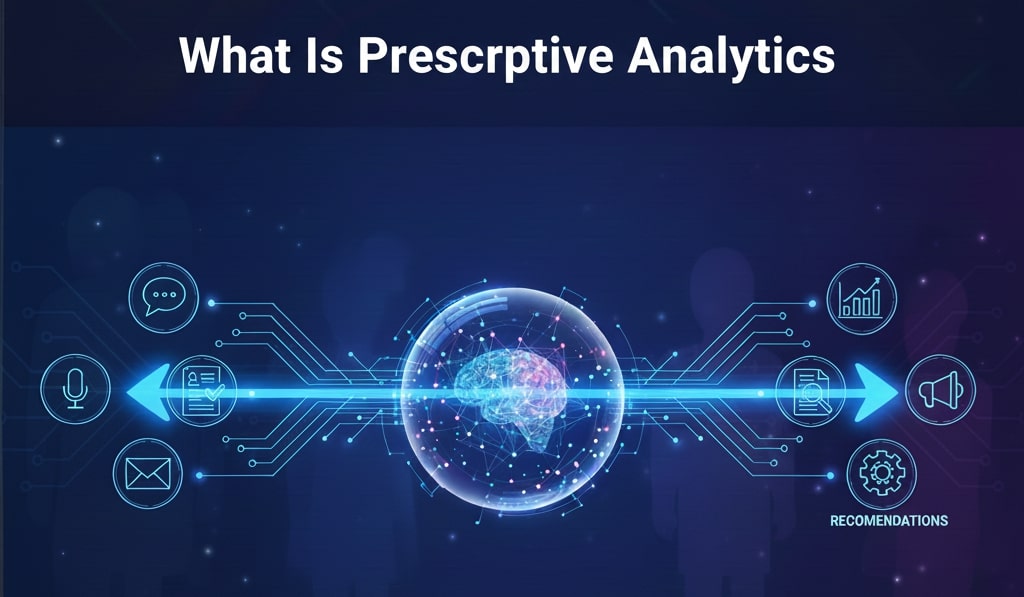
Prescriptive analytics leverages advanced methodologies to simulate thousands of possible scenarios under varying constraints and objectives. At its core, it combines:
- Optimization Algorithms: Techniques like genetic algorithms, integer programming, and heuristics to solve complex resource-allocation problems.
- Simulation Models: Monte Carlo simulations and what-if analyses to account for stochastic variables and uncertainties in campaign performance.
- Machine Learning: Predictive components that refine the accuracy of forecasts by learning from historical data, seasonality, and user behaviors.
The output is a ranked set of recommended actions—such as bid adjustments, budget reallocations, or content personalization rules—each tied to projected ROI uplift or cost savings.
Key Benefits of Prescriptive Analytics in Marketing

Adopting a prescriptive approach delivers measurable advantages:
- Maximized ROI: Allocate every dollar where it will have the greatest incremental impact on conversions or revenue.
- Personalization at Scale: Serve the right message to each audience segment by dynamically adjusting creative, channel, and timing.
- Real-Time Agility: React instantly to performance variances by automating bid, budget, or content rules based on live data inputs.
- Reduced Experimentation Costs: Minimize manual A/B tests and hypotheses by relying on model-driven recommendations that have demonstrable uplift.
These benefits cumulatively free marketing teams to focus on strategic planning and creative execution rather than manual optimizations.
Core Use Cases
Prescriptive analytics is a force multiplier across multiple marketing domains:
- Programmatic Media Buying: Algorithms continuously rebalance bids across exchanges and ad formats to meet target CPA or ROAS goals.
- Email Campaign Management: Dynamically optimize send times, subject lines, and segment selection based on opens, clicks, and historical response patterns.
- Cross-Channel Budgeting: Simultaneously allocate spend across search, social, display, and affiliate networks to hit overall revenue targets while respecting individual channel caps.
- Content Strategy: Prioritize topics, formats, and publishing cadences by modeling engagement and conversion probabilities for each content asset.
By embedding prescriptive engines into campaign workflows, organizations orchestrate synchronized, data-driven experiences across customer touchpoints.
Top Tools and Technologies
When evaluating prescriptive analytics platforms, look for solution providers offering:
- End-to-End Workflows: From data ingestion and feature engineering to model training, recommendation generation, and seamless activation in ad servers or marketing automation tools.
- Explainable AI: Transparent decision paths and confidence scores to build stakeholder trust.
- Scalability and Performance: Cloud-native architecture that can process billions of events daily and recompute prescriptions in near real time.
- Open Integrations: Robust APIs and pre-built connectors for CRM, analytics suites, DSPs, and CDPs.
Examples of leading options include Adobe Sensei for automated content and audience recommendations, Google Marketing Platform’s data-driven attribution and bidding engine, IBM Watson Studio for custom optimization pipelines, and specialized vendors like Optimove and SAS Customer Intelligence.
Implementing Prescriptive Analytics: A Step-by-Step Approach

Follow this structured roadmap to ensure a successful deployment:
- Define Clear Objectives: Establish quantifiable goals—such as reducing customer acquisition cost by 20% or increasing average order value by $15—and map them to specific prescriptive use cases.
- Audit and Unify Data Sources: Consolidate CRM records, web analytics data, ad platform metrics, and offline touchpoints into a centralized data warehouse or customer data platform (CDP).
- Feature Engineering: Create predictive features like recency/frequency metrics, seasonal indicators, and propensity scores to feed into models.
- Model Development and Validation: Train predictive models and rigorously test them against holdout datasets to ensure accuracy across different scenarios and customer segments.
- Optimization and Simulation: Layer optimization algorithms on top of predictive outputs, running simulations to quantify the incremental impact of each recommended action under various market conditions.
- Integration and Automation: Deploy the prescriptive engine via APIs or native connectors into campaign management systems so that recommendations automatically trigger bid changes, budget shifts, or content personalization rules.
- Monitoring and Continuous Improvement: Set up dashboards to compare actual performance against model prescriptions, feeding results back into the system for ongoing retraining and refinement.
By breaking down the project into these stages, you reduce risk, accelerate time to value, and secure stakeholder buy-in at each milestone.
Best Practices for Success
To maximize the impact of prescriptive analytics, adhere to these guidelines:
- Start with High-Value Pilots: Identify one or two critical use cases—such as paid search bid optimization or email send-time personalization—and prove value before scaling across channels.
- Ensure Cross-Functional Collaboration: Involve marketing operations, data science, IT, and finance teams from the outset to align on objectives, data requirements, and integration points.
- Maintain Transparency and Explainability: Choose models and algorithms that offer clear rationale for each recommendation—this fosters trust among campaign managers and executives.
- Invest in Data Literacy: Train marketing stakeholders on the fundamentals of prescriptive analytics so they can interpret results and provide qualitative feedback.
Common Challenges and How to Overcome Them
Even with a robust strategy, teams often face obstacles such as fragmented data, legacy systems, and organizational resistance to algorithmic decision-making. Address these by:
- Implementing Strong Data Governance: Define data ownership, quality standards, and access controls to ensure clean, reliable inputs into your prescriptive engine.
- Driving Change Management: Offer workshops, hands-on training, and pilot programs that demonstrate quick wins and build confidence in prescriptive recommendations.
- Planning for Scalability: Architect your solution on a cloud infrastructure that can elastically scale with data volume, event velocity, and user load.
Ethical Considerations and Responsible Prescriptive Analytics
As marketing organizations increasingly rely on prescriptive analytics to make automated recommendations, it’s critical to embed ethical principles and responsible practices throughout your workflow. While these algorithms optimize performance and ROI, they also have the potential to impact customers’ experiences, privacy, and trust.
Key Considerations:
-
Data Privacy and Compliance: Ensure all customer data used in prescriptive models complies with GDPR, CCPA, and other local regulations. Avoid using sensitive or personally identifiable information in ways that could breach trust.
-
Bias and Fairness: Algorithms can inadvertently amplify biases present in historical data. Regularly audit models to detect and mitigate biases that may unfairly disadvantage certain customer segments.
-
Transparency and Explainability: Make recommendations understandable to marketers and stakeholders. Clearly communicate why a particular action is suggested and the expected impact.
-
Customer-Centric Ethics: Avoid manipulative practices, such as hyper-targeting vulnerable audiences or using overly aggressive personalization that could harm brand perception.
-
Sustainable Automation: Balance automated recommendations with human oversight to ensure alignment with long-term brand values and corporate responsibility.
By integrating ethical guardrails into prescriptive analytics workflows, organizations not only optimize performance but also maintain customer trust and brand integrity—key drivers of sustainable marketing success.
Conclusion
Prescriptive analytics is the definitive leap from insight to action, empowering marketing organizations to optimize every aspect of their campaigns—bid strategies, budget allocations, content personalization, and more—with mathematical precision. By following a structured implementation roadmap, selecting the right technologies, and fostering a culture of data literacy and cross-functional collaboration, you can unlock measurable performance gains and secure a sustainable competitive advantage. Embrace prescriptive analytics today to transform raw data into recommended strategies that drive growth, enhance customer experiences, and maximize ROI.
FAQ: Prescriptive Analytics in Marketing
1. What makes prescriptive analytics different from predictive analytics?
Prescriptive analytics doesn’t just predict future outcomes — it recommends the specific actions marketers should take to achieve the best possible results. Predictive analytics stops at forecasting, while prescriptive analytics turns predictions into optimized strategies.
2. Do teams need deep machine learning expertise to use prescriptive analytics?
Not always. Many modern platforms offer automated workflows, pre-built models, and no-code interfaces. However, building fully customized models or integrating with complex systems may require data science support.
3. Can prescriptive analytics integrate with existing marketing tools?
Yes. Most prescriptive solutions connect easily to CRM systems, CDPs, advertising platforms, and analytics tools through APIs and native integrations, making adoption smoother.
4. Is prescriptive analytics only valuable for large enterprises?
It’s beneficial for companies of all sizes. Any business dealing with multi-channel campaigns, personalization, or large datasets can gain value from prescriptive insights.
5. Will prescriptive analytics replace human marketers?
No. It enhances human decision-making by handling data-heavy optimizations, while marketers still guide strategy, creativity, messaging, and brand experience.
6. Does prescriptive analytics require real-time data to work effectively?
Real-time data improves accuracy for rapid decision-making, but many strategic use cases—like budgeting or content planning—perform well with periodic data updates.
7. How does prescriptive analytics improve marketing ROI?
It allocates budgets, bids, and actions toward the highest-impact opportunities, ensuring every dollar is spent efficiently. This often leads to noticeable improvements in conversions, revenue, and cost savings.
8. Why is data quality important for prescriptive analytics?
Prescriptive models depend on reliable, clean, and unified data. Poor-quality data leads to inaccurate predictions and ineffective recommendations.
9. Do prescriptive models require ongoing monitoring?
Yes. As customer behavior, market conditions, and campaign performance evolve, models need periodic evaluation and retraining to remain accurate.
10. Can prescriptive analytics support content and personalization strategies?
Absolutely. It can recommend the ideal message, timing, and channel for each audience segment based on predicted engagement and conversion likelihood.
11. Is it expensive to get started with prescriptive analytics?
Not necessarily. Teams can begin with small-scale pilot programs or use features available in existing martech platforms before investing in enterprise solutions.
12. How does prescriptive analytics impact A/B testing?
It reduces the need for manual testing by simulating a wide range of scenarios and identifying the best-performing strategy without running dozens of real-world experiments.
Read more about this topic: Leveraging Data-Driven Storytelling in Marketing Analytics
 Donald Abel