
Unlock the full potential of your brand. Discover how Marketing Analytics Services transform raw data into a powerhouse of actionable insights, driving sustainable growth and unrivaled competitive advantage.
This guide explores the evolution of Marketing Analytics Services, from descriptive data to AI-driven predictive trends. We cover essential tools like Google Analytics, strategies for customer journey mapping, and how to align brand positioning with data to maximize your ROI in an increasingly digital landscape.
Convert data into growth with smarter marketing analytics.
In the modern business landscape, advertising is no longer a “spray and pray” endeavor. It is the direct effect of your marketing activities, but without a compass, you are sailing blind. Marketing Analytics Services provide that compass. They sit at the intersection of technology and psychology, helping companies utilize marketing analytics data to understand the “why” behind the “what.”
Whether you are navigating CPG brand marketing or building a luxury brand marketing strategy, the ability to translate clicks into customers is what defines market leaders.
1. The Core of Marketing Analytics Services
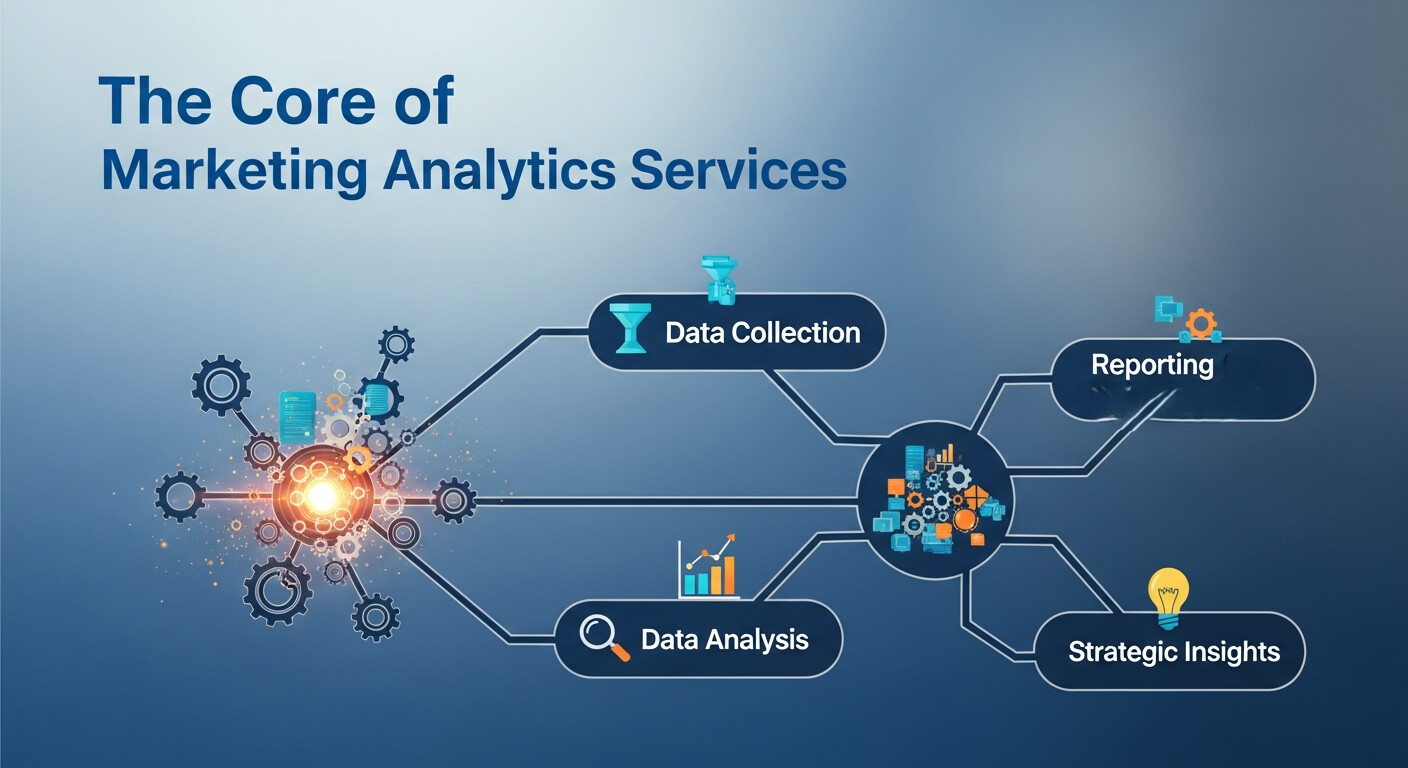
At its heart, Marketing Analytics Services are specialized solutions designed to aggregate, process, and interpret data generated across the digital ecosystem. From mobile app marketing analytics to email marketing analytics, these services provide a holistic view of the customer.
The Fundamental Pillars:
- Data Integration: Consolidating information from social media, CRM platforms, and advanced web analytics.
- Visualization: Using marketing analytics tools like Tableau to create intuitive dashboards.
- Actionable Intelligence: Moving beyond vanity metrics to focus on Brand Equity KPIs and conversion rates.
2. The Spectrum of Analytics: From Hindsight to Foresight
To truly master your market, you must understand the four levels of analytics. Each plays a role in integrated marketing and brand resilience strategies.
Descriptive Analytics: What Happened?
This is the foundation. It tracks brand awareness and historical performance.
- Metrics: Impressions, CTR, and digital marketing success stories from past quarters.
- Value: It provides the “baseline” for your brand audit.
Predictive Analytics: What Will Happen?
Using AI-driven trend forecasting, businesses can now anticipate market shifts.
- Application: Predictive trend marketing helps a fashion marketing strategy stay ahead of seasonal shifts.
- Tools: Machine learning models that analyze chemical market analytics or consumer demand.
Prescriptive Analytics: How Can We Make It Happen?
This is the most “aggressive” form of analytics. It provides a brand strategy roadmap.
-
Example: An algorithm suggesting you shift budget to SMS marketing because it predicts a 15% higher engagement rate for your target demographic.
Real-Time Analytics: What Is Happening Now?
Crucial for viral social media campaigns and real-time trend marketing. If a post goes viral on TikTok, real-time analytics allow you to capitalize on the psychology of trend marketing before the window closes.
3. Mapping the Customer Journey
Modern marketing is not a straight line; it is a complex web. Customer journey analytics and customer journey mapping are essential for understanding how a user moves from “Who are you?” to “Take my money.”
| Stage | Analytics Focus | Key Marketing Activity |
| Awareness | Brand Perception In Marketing | Influencer Marketing Services |
| Consideration | Event Marketing Analytics | Creative Webinar Ideas |
| Conversion | Mobile App Marketing Analytics | Digital Payment Solutions |
| Retention | Email Marketing Analytics | Referral Marketing |
4. Branding and Analytics: A Powerful Synergy
Data should never strip away the soul of a brand. Instead, Marketing Analytics Services should reinforce your brand voice strategy and brand storytelling.
- Brand Positioning Strategy: Use data to find the “white space” in the market. Competitive brand analysis reveals where rivals are failing.
- Brand Personality in Marketing: Analytics can tell you if your audience perceives you as “The Hero” or “The Sage” based on engagement with different content styles (Brand Archetypes Framework).
- Brand Safety in Digital Marketing: Ensure your ads aren’t appearing next to “negative content” by using brand monitoring services.
5. Essential Marketing Analytics Tools
To compete, you need a robust tech stack. Here are the industry standards:
- Google Analytics 4 (GA4): The gold standard for Advanced Web Analytics.
- SEMrush & Ahrefs: Essential for Measuring SEO Success and ethical link building.
- HubSpot: The powerhouse for Inbound Marketing and B2B digital marketing strategies.
- Hootsuite: For deep dives into social media management and viral content marketing.
- Tableau: For high-level data visualization and brand equity reporting.
6. The Rise of Video and Sonic Branding
The video analytics market trend shows no signs of slowing down. Mastering video analytics is now a requirement for any viral content strategy.
- Partnership Marketing with Video Analytics: Tracking how co-branded video content performs across different platforms.
- Sonic Branding: Using audio cues to build brand consistency. Analytics can measure “audio recall” and its impact on brand awareness.
7. Overcoming Challenges: The “Dark Side” of Data
While data is powerful, it has pitfalls. Marketing analytics hacks can sometimes lead to “brand cannibalization” if you focus too much on short-term wins.
- Privacy-First Analytics: With GDPR and evolving regulations, ethical branding is now a data requirement.
- Brand Crisis Management: Using reputation management tools to catch a PR fire before it spreads. Crisis management services use sentiment analysis to guide a brand refresh or recovery.
8. Case Studies: Data in Action
Case Study 1: The Viral Pivot
A mid-sized tech firm used viral marketing psychology to build a viral marketing funnel. By analyzing micro trend marketing on TikTok, they created a “challenge” that resulted in a 300% increase in brand authority within two weeks.
Case Study 2: SaaS Growth
A SaaS development services provider utilized product-led growth analytics to identify where users were dropping off. By simplifying the UI (brand simplification), they boosted retention by 40%.
9. Selecting the Right Service Provider
When choosing Marketing Analytics Services, look for a partner that offers:
- Scalability: Can they handle your global brand adaptation strategies?
- Integration: Do they connect with your payment gateway solutions?
- Expertise: Do they have a digital marketing expert role dedicated to your account?
Advanced Segmentation: Beyond Basic Demographics
To truly excel, Marketing Analytics Services must move beyond age and location. The future of high-conversion campaigns lies in psychographic segmentation and behavioral clustering.
- Behavioral Triggers: By analyzing marketing analytics data, brands can identify specific actions—like visiting a pricing page three times in 48 hours—to trigger an automated outbound email marketing sequence.
- Predictive Churn Analysis: Analytics services can flag customers who show signs of disengagement, allowing for a proactive brand resilience strategy to win them back before they leave.
The Power of Integrated Marketing Communications (IMC)
In a fragmented digital world, your message must be consistent. Integrated marketing ensures that your brand voice is the same on a TikTok viral video as it is in a formal whitepaper.
- Cross-Channel Attribution: One of the biggest “marketing analytics hacks” is multi-touch attribution. This tells you that while a customer bought through a Google ad, they first discovered you via a social media management post and a creative webinar.
- Building Brand Consistency: Analytics tools monitor visual and tonal consistency across all platforms, ensuring your brand strategy framework remains intact globally.
Niche Analytics: Chemical to Luxury Markets
Different industries require different analytical lenses. Marketing Analytics Services are not “one size fits all.”
Chemical Market Analytics
In B2B industrial sectors, the focus is on long-term supply chain trends and partnership marketing. Analytics here help in forecasting demand for raw materials and identifying high-value institutional leads.
Luxury Brand Marketing Strategy
For high-end brands, high volume isn’t the goal—exclusivity is. Luxury brand marketing analytics focus on brand perception in marketing and “sentiment scores” rather than just click-through rates. It’s about maintaining the brand aura while utilizing digital reputation management.
Modern Lead Generation: From Webinars to SMS
The tools we use to capture leads are evolving, and so is the data we get from them.
- Webinar Sales Funnel: Using trending webinar topics to attract leads and then analyzing engagement rates (how long they stayed, what questions they asked) to score the lead’s quality.
- Irresistible Webinar Offers: Analytics can tell you exactly at what minute in your presentation people tend to drop off, allowing you to move your “call to action” to an earlier, high-engagement slot.
- WhatsApp & SMS Marketing Services: These channels offer nearly 98% open rates. Analytics here focus on “time-to-open” and direct conversion, making them essential for marketing FOMO (Fear Of Missing Out) campaigns.
Technical SEO and Growth Hacking

You cannot have a data-driven strategy without a solid technical foundation. SEO services and web design & development must be integrated with your analytics.
- Measuring SEO Success: It’s more than just rankings. It’s about “Share of Voice.” How often does your brand appear compared to competitors for high-intent keywords?
- Ethical Link Building: Using guest posting services to build brand equity in marketing without triggering search engine penalties.
- App Development Services: If you have a mobile presence, mobile app marketing analytics are vital to track “stickiness” and user lifetime value (LTV).
Protecting the Brand: Risk and Reputation
a single tweet can spark a crisis. Brand monitoring services are your early warning system.
- Brand Crisis Management Services: When a negative trend starts, real-time analytics allow you to respond within minutes. This is the heart of digital reputation management.
- Review Management Services: Actively monitoring and responding to reviews on Google and Yelp to improve brand perception.
- Brand Audit: A bi-annual deep dive into your data to ensure your brand positioning hasn’t drifted away from your core brand purpose development.
Conclusion
The transition from “guessing” to “knowing” is the hallmark of a successful modern business. Marketing Analytics Services are the engine of that transition. By embracing data-driven brand marketing strategies, you don’t just survive the noise—you lead the conversation. It’s time to move beyond the “want” and embrace the “need.
Frequently Asked Questions
1. What exactly are Marketing Analytics Services?
Marketing Analytics Services combine expert strategy with software tools to collect, organize, and analyze data from multiple marketing channels. They help businesses understand customer behavior, improve engagement, optimize campaigns, and increase ROI by turning raw data into actionable insights for smarter, faster marketing decisions.
2. How do Marketing Analytics Services improve SEO?
They track keyword performance, backlinks, traffic sources, and user behavior to measure SEO success. These insights help refine content strategy, improve site structure, and identify ranking opportunities, allowing brands to boost organic visibility, attract qualified traffic, and continuously optimize search engine performance.
3. What is the difference between Inbound and Outbound Marketing Analytics?
Inbound analytics focuses on content engagement, lead nurturing, and conversion paths from blogs, social media, and search. Outbound analytics measures reach, impressions, email open rates, and direct responses from paid ads or cold outreach. Together, they provide a complete view of customer acquisition performance.
4. Can small businesses afford advanced Marketing Analytics Services?
Yes. Many powerful tools like Google Analytics are free, while SaaS platforms offer affordable tiered plans. Small businesses can start with basic tracking and scale gradually as they grow, making data-driven marketing accessible even on limited budgets.
5. How does AI impact trend marketing?
AI analyzes social conversations, search patterns, and news in real time to identify emerging trends early. This allows brands to react faster, create relevant content, and launch timely campaigns. AI-driven trend marketing helps businesses stay competitive by predicting consumer interests before they peak.
6. What is Customer Journey Mapping?
Customer Journey Mapping visualizes every interaction a customer has with your brand—from first awareness to purchase and retention. It reveals pain points, drop-off stages, and engagement moments, helping marketers optimize touchpoints, personalize experiences, and improve conversions across the entire customer lifecycle.
7. Why is “Brand Safety” important in digital marketing?
Brand safety ensures ads don’t appear beside harmful or inappropriate content. This protects brand reputation, maintains customer trust, and supports long-term digital credibility. Strong brand safety practices are essential for effective reputation management and responsible advertising in today’s automated media landscape.
8. What are “Marketing Analytics Hacks”?
Marketing analytics hacks are smart, data-driven tactics like A/B testing landing pages, optimizing high-intent keywords, or using FOMO in campaigns. These quick-win strategies help improve conversions faster by focusing on what already performs well, saving time while maximizing measurable results.
9. How do you measure Brand Equity?
Brand Equity is measured using KPIs such as brand awareness, customer loyalty, perceived quality, and emotional associations. Surveys, social listening, and engagement metrics help quantify how consumers value your brand, guiding strategic decisions that strengthen long-term market position.
10. What is the future of Marketing Analytics?
The future focuses on privacy-first data, AI-powered predictions, voice analytics, and hyper-personalized experiences. Marketers will rely more on ethical tracking and predictive insights to deliver relevant content while respecting user privacy, creating smarter, trust-based customer relationships.