

This comprehensive guide reveals how to transform your creative output into a measurable, revenue-generating machine. You will learn the exact steps to build a data driven content marketing strategy, compare the best content intelligence platforms, discover pro tips for maximizing return on investment, and find out how to avoid the most common industry mistakes.
Are you tired of guessing what your audience wants to read? Creating content based on gut feelings is a recipe for wasted time and lost revenue. To truly connect with your audience and dominate search engine results, you need a robust data driven content marketing approach.
Understanding Data Driven Content Marketing
Data driven content marketing eliminates the guesswork from your publishing schedule. Instead of brainstorming topics based on assumptions, you rely on hard numbers to dictate what you create, where you publish it, and how you measure its success. This approach utilizes website analytics, search trends, customer behavior metrics, and conversion data to guide every creative decision your team makes.
When you leverage a data driven content marketing strategy, you ensure every blog post, video, and whitepaper serves a distinct business purpose. You stop creating content just to meet a deadline. Instead, you develop targeted assets that answer your audience’s specific questions, guide them through the buying process, and ultimately drive them to make a purchase.
According to research from the Content Marketing Institute, organizations that document and measure their strategies are significantly more likely to report positive ROI. By analyzing how users interact with your digital presence, you can uncover hidden opportunities, identify content gaps, and allocate your marketing budget to the channels that actually deliver results.
Why Your Business Needs a Data-Driven Approach

The digital landscape is more crowded than ever. Publishing generic articles and hoping for the best simply does not work. You need a competitive edge, and data provides it.
Here are the primary reasons you must adopt this methodology:
- Proven Return on Investment: Leadership teams demand to see how marketing dollars translate into revenue. Data allows you to attribute specific sales and leads to individual pieces of content.
- Deep Audience Understanding: Analytics reveal exactly how your target buyers behave. You learn what formats they prefer, what time of day they read, and which pain points drive them to seek solutions.
- Resource Optimization: When you know which topics perform well, you stop wasting money on assets that nobody reads. You can focus your time and budget on high-converting content clusters.
- Predictable Growth: Analyzing historical performance allows you to predict future trends. You can spot rising search queries and establish authority in your niche before your competitors catch on.
To unlock these benefits, you must integrate your data analysis with a comprehensive content marketing plan that aligns your creative efforts with your overarching business objectives.
Step-by-Step Guide to Building Your Strategy
Transitioning to a data-centric model requires a systematic approach. Follow these steps to build a framework that consistently generates traffic and leads.
Step 1: Define Clear Goals and KPIs
You cannot measure success if you do not define it first. Before you look at any data, establish what you want your content to achieve. Are you trying to increase brand awareness, generate qualified leads, or improve customer retention?
Once you define your goals, attach Key Performance Indicators (KPIs) to them. If your goal is brand awareness, track organic traffic, social shares, and time on page. If your goal is lead generation, monitor conversion rates, form submissions, and cost per acquisition.
Step 2: Conduct Deep Audience and Market Analysis
Knowing your audience is the foundation of data driven content marketing. Move beyond basic demographics and dive into behavioral data. Use heat maps, session recordings, and customer relationship management (CRM) software to see how users interact with your website.
Combine this quantitative data with qualitative insights from customer surveys and sales team interviews. Use this combined intelligence to build a highly detailed buyer persona map. This map will serve as the guiding document for all your content creation, ensuring you speak directly to your ideal customer’s specific needs and pain points.
Step 3: Run a Comprehensive Content Audit
You likely already have a wealth of data sitting in your archives. Run a content audit to evaluate the performance of everything you have published over the last year.
Identify your top-performing assets. What do they have in common? Look at the format, length, tone, and topic. Conversely, identify the content that receives zero traffic or has a high bounce rate. Analyzing your failures is just as important as analyzing your successes. Use this audit to decide which pieces to update, which to consolidate, and which to delete entirely.
Step 4: Identify Content Gaps and Opportunities
Use SEO tools to conduct keyword research and competitive analysis. Find out what terms your competitors rank for that you currently miss. Look for high-volume, low-competition keywords that align with your product offerings.
However, do not just look at search volume. Look at search intent. Ensure the content you plan to create directly answers the user’s underlying question. If someone searches for “how to fix a leaky faucet,” they want a tutorial, not a product page selling wrenches.
Step 5: Implement Multi-Channel Attribution
Customer journeys are complex. A buyer might read a blog post, click a social media ad two weeks later, and finally convert after receiving an email newsletter. If you only track the last touchpoint, you miss the true value of your content.
Implement multi-touch attribution models to understand how different pieces of content work together to drive sales. Connect your analytics platforms with your marketing automation software to track the entire lifecycle of a lead.
Top Content Intelligence Tools Compared
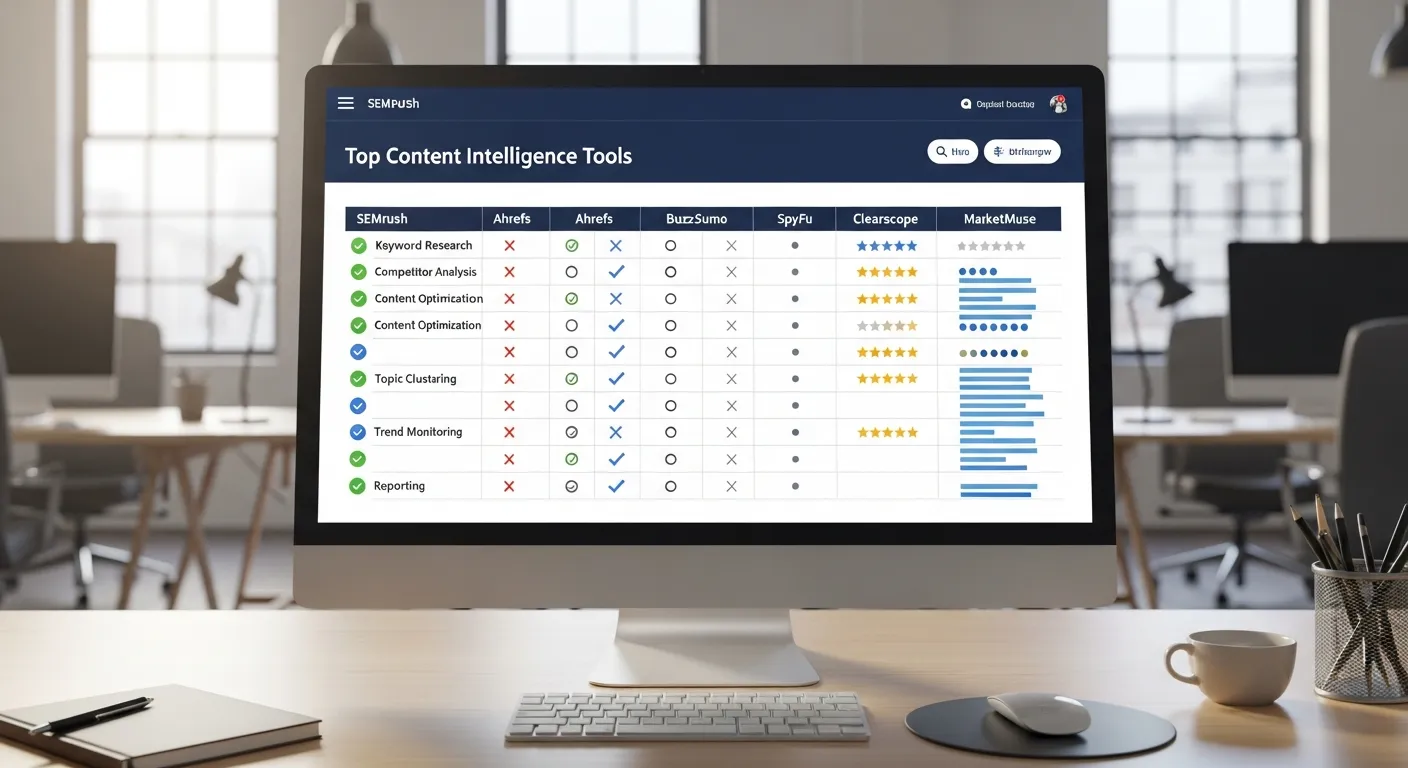
To execute data driven content marketing effectively, you need the right technology stack. Here is a comparison of top-tier platforms that provide actionable insights.
|
Tool Name |
Primary Strength |
Key Features |
Best Use Case |
|---|---|---|---|
|
Semrush |
Search Engine Optimization |
Keyword gap analysis, backlink tracking, site audits |
Comprehensive SEO strategy and competitor research |
|
Ahrefs |
Backlink and Content Analysis |
Content explorer, keyword difficulty metrics, rank tracking |
Finding highly shared content and link-building opportunities |
|
MarketMuse |
Content Optimization |
AI-driven content briefs, topic modeling, inventory analysis |
Ensuring topical authority and comprehensive content depth |
|
Siteimprove |
Website Performance |
Accessibility checks, quality assurance, ROI dashboards |
Enterprise teams needing full-site governance and analytics |
|
Clearscope |
On-Page SEO |
Real-time grading, LSI keyword suggestions, readability scores |
Writers optimizing individual articles for search intent |
When selecting tools, ensure they integrate smoothly with your existing marketing automation strategies to keep your data centralized and actionable.
Common Mistakes to Avoid
Even seasoned marketers stumble when transitioning to a data-centric model. Avoid these frequent errors to keep your strategy on track.
Focusing on Vanity Metrics
Page views and social media likes feel good, but they do not pay the bills. If a blog post gets 10,000 views but generates zero leads or sales, it failed its business objective. Focus on metrics that tie directly to revenue, such as conversion rates, lead quality, and customer acquisition cost.
Ignoring Qualitative Data
Numbers tell you what is happening, but they rarely tell you why. Do not rely entirely on dashboards. Talk to your sales team, interview your best customers, and read the comments on your social media posts. Qualitative feedback provides the context you need to interpret your quantitative data accurately.
Working in Silos
Data driven content marketing fails when teams do not share information. If your SEO team, social media managers, and content writers use different platforms and track different metrics, your strategy will fracture. Establish a single source of truth and hold regular cross-departmental meetings to align your efforts.
Setting and Forgetting Content
Publishing an article is only the first step. Search intent changes, industry trends shift, and competitors publish new material. If you do not regularly revisit and update your historical content based on fresh data, your rankings and traffic will slowly decay.
Expert Tips and Pro Strategies
Ready to take your marketing to the next level? Implement these advanced tactics used by industry leaders.
- A/B Test Everything: Never assume you know what works best. A/B test your headlines, call-to-action buttons, email subject lines, and landing page layouts. Let the data declare the winner.
- Leverage Predictive Analytics: Advanced AI tools can analyze your historical performance to predict future outcomes. Use these insights to forecast which topics will trend next month and publish content before your competitors do.
- Personalize Content at Scale: Use behavioral data to deliver personalized experiences. If a user frequently reads articles about email marketing, use dynamic content blocks on your website to recommend an advanced email marketing guide or webinar.
- Build Content Clusters: Do not write isolated articles. Use data to identify broad core topics, then create a comprehensive “pillar” page surrounded by related “cluster” articles. Link them all together to signal topical authority to search engines.
- Repurpose High-Performing Assets: When the data shows a particular blog post is highly popular, extract maximum value from it. Turn the key points into a short video, an infographic, a podcast episode, and a series of social media posts.
Integrating AI into Your Data Strategy

Artificial intelligence has fundamentally changed how we analyze marketing data. AI tools can process massive datasets in seconds, uncovering patterns and anomalies that a human analyst might miss.
You can use AI to conduct sentiment analysis on customer reviews, automatically tag and categorize your content inventory, and generate detailed content briefs based on top-ranking search results. However, remember that AI is a tool, not a replacement for human creativity. Use AI to gather insights and structure your data driven content marketing strategy, but rely on human writers to inject empathy, storytelling, and unique perspectives into the final product.
To learn more about how technology is shaping search, refer to authoritative guides published by organizations like Google Search Central and the Content Marketing Institute. These resources provide continuous updates on algorithm changes and data analysis best practices.
Conclusion
Succeeding in today’s digital ecosystem requires more than just good writing; it requires strategic intelligence. Data driven content marketing empowers you to stop guessing and start growing. By setting clear KPIs, analyzing audience behavior, auditing your existing assets, and using advanced content intelligence tools, you can create a highly efficient marketing engine that consistently delivers measurable ROI. Start looking at your analytics today, identify your biggest content gaps, and let the data guide your next campaign.
FAQs
1. What is data driven content marketing?
It is the process of using quantitative and qualitative data—such as website analytics, search trends, and customer behavior—to inform your content strategy. It ensures that every piece of content you create serves a specific, measurable business goal.
2. How do I measure the ROI of my content?
To measure ROI, you must track how much revenue a piece of content generated compared to how much it cost to produce. Use multi-touch attribution models in your CRM to see how specific blog posts or videos contributed to closing a sale.
3. What are the most important metrics to track?
While it depends on your goals, the most crucial metrics typically include conversion rate, time on page, organic traffic growth, bounce rate, and lead quality. Always prioritize metrics that connect directly to business revenue over vanity metrics like page views.
4. How often should I audit my content?
You should conduct a comprehensive content audit at least once a year. However, it is best practice to review your top-performing and lowest-performing pages on a quarterly basis so you can make quick adjustments and updates.
5. What is a content gap analysis?
A content gap analysis involves comparing your current content inventory against the needs of your audience and the content your competitors offer. It helps you identify topics and keywords you have missed so you can create new assets to capture that traffic.
6. Can small businesses afford data driven content marketing?
Yes. While enterprise-level tools can be expensive, small businesses can start with free or low-cost tools like Google Analytics, Google Search Console, and basic CRM reporting to gather powerful insights and optimize their strategies.
7. How does data help with content personalization?
Data tells you how individual users interact with your brand. By tracking a user’s browsing history, past purchases, and email engagement, you can use automation tools to display content and offers that match their specific interests.
8. Should I write for search engines or human readers?
You must write for humans while optimizing for search engines. Use data to understand the keywords and structures search engines prefer, but always ensure the final content is highly readable, engaging, and genuinely helpful to a human audience.
9. What role does A/B testing play in content marketing?
A/B testing allows you to compare two versions of a webpage, email, or headline to see which performs better. It removes subjectivity from design and copywriting decisions, ensuring you always use the version that yields the highest conversion rate.
10. Why is qualitative data important if I already have analytics?
Analytics (quantitative data) tell you what users are doing, such as bouncing off a page after ten seconds. Qualitative data (like surveys or user testing) tells you why they are doing it, such as finding the page layout confusing or the content unhelpful. You need both to succeed.
 Rosemary Barker