

Marketing analytics metrics help businesses track performance, understand customer behavior, and optimize campaigns. By using data-driven insights, marketers can improve decision-making, boost ROI, and achieve measurable growth across digital marketing channels.
What is Marketing Analytics and Why Does it Matter?
Marketing analytics is essentially analyzing how well (or how poorly) marketing activities are performing. It’s related to monitoring, measuring, and analyzing business metrics such as website visits, customer interaction, and return on investment (ROI).
But why is it important? To put it plainly, guesswork marketing is a thing of the past for companies. With accurate data:
- You can use data-informed decisions to concentrate on what is working.
- You can maximize the utilization of the resources and make certain that time and money are effectively used.
- You are offered clearer customer insights, making it easier to craft highly targeted campaigns.
Whether you are a small startup or a large organization, marketing analytics can help you conceive of more intelligent campaigns that offer better results.
Essential Key Performance Indicators in Marketing Metrics in Analytics

Website Traffic Analysis
It’s not surprising, then, that website traffic is the first metric many businesses analyze. It shows how many people are coming to your website, and how they are engaging with your content. Key performance indicators (KPIs) are:
- Sessions: The overall visits to your website.
- Bounce rate: The percentage of visitors who leave after viewing one page.
- Traffic sources: Find out if visitors arrive through search engines, ads, social media, or referrers.
With tools like Google Analytics, you can dive deep into trends and behaviors, such as which pages perform best and in what sequence visitors generally interact with your site.
Social Media Engagement
Social networks are most valuable for current market conditions. By monitoring engagement numbers on platforms such as Facebook, Instagram, and TikTok, for example, you can learn how people are interacting with your content. Metrics include:
- Likes, clicks, and comments for content resonance.
- Growth for followers for brand exposure.
- Click-Through Rates (CTR) from social posts to the website.
For instance, if you see a spike in comments, it might mean your campaign worked, but depressingly low levels of engagement may mean you need a strategy shake-up.
Email Marketing Performance
Email is one of the most effective channels for growing customer loyalty. Analytics can measure such metrics as:
- Open Rate: The percent of people who open your email.
- Click-to-open rate (CTOR): Number of clicks divided by number of opens, indicating the quality of an email.
- Unsubscribe rate – to keep the content engaging.
You can apply these insights to create more effective emails and build lasting customer relationships.
Conversion Rates and ROI
When it comes down to it, the results of any marketing campaign come in the form of conversions and ROI. Conversion rates simply let you know how many people did a thing you wanted them to do — sign up for a service, buy a product, etc.
- Conversion rate formula = (Conversions / Total visitors) * 100.
- ROI equation = (Amount generated – cost of campaign) / cost of campaign.
You can calibrate better marketing performance on these metrics over time.
Marketing Analytics Metrics by Funnel Stage
Marketing analytics metrics become more powerful when aligned with the customer journey. Different stages of the marketing funnel require different metrics to measure effectiveness accurately. Tracking the right metrics at each stage helps marketers identify drop-offs, optimize touchpoints, and improve overall performance.
By mapping marketing analytics metrics to funnel stages, businesses can ensure that their campaigns are driving awareness, engagement, and conversions effectively.
Key Benefits of Funnel-Based Metrics
- Provides clearer visibility into customer behavior
- Helps optimize campaigns at each funnel stage
- Improves conversion rate and ROI tracking
- Supports data-driven campaign adjustments
Marketing Analytics Metrics Across the Funnel
| Funnel Stage | Key Metrics Tracked | Purpose |
|---|---|---|
| Awareness | Impressions, Reach, Website Traffic | Measure brand visibility |
| Consideration | Engagement Rate, Time on Site, CTR | Track audience interest |
| Conversion | Conversion Rate, Cost per Conversion | Measure campaign success |
| Retention | Repeat Visits, Email Open Rate | Build customer loyalty |
| Advocacy | Social Shares, Reviews, Referrals | Encourage brand promotion |
Using funnel-based marketing analytics metrics ensures better decision-making and long-term growth.
Using Marketing Analytics Metrics for Continuous Optimization
Marketing analytics metrics are not just for reporting—they are essential for continuous optimization. Regularly monitoring metrics like conversion rates, engagement trends, and funnel drop-offs allows marketers to identify what needs improvement. Small adjustments to headlines, creatives, targeting, or timing can lead to significant performance gains when guided by data. A/B testing combined with analytics metrics helps validate decisions before scaling campaigns. Continuous optimization ensures marketing strategies stay aligned with changing customer behavior and market trends. By consistently acting on insights from marketing analytics metrics, businesses can improve efficiency, increase conversions, and maintain a competitive edge in fast-moving digital environments.
How Marketing Analytics Metrics Improve Budget Allocation
One of the biggest advantages of marketing analytics metrics is smarter budget allocation. By tracking cost per acquisition (CPA), ROI, and channel performance, marketers can clearly see which campaigns generate the best returns. These insights help eliminate wasted spend on underperforming channels and redirect budgets toward high-impact activities. For example, if analytics show paid search delivers higher conversions than social ads, funds can be adjusted accordingly. Marketing analytics metrics also support forecasting and performance comparisons over time. This data-driven budgeting approach reduces guesswork, improves efficiency, and ensures marketing investments align with business goals. Ultimately, better budget decisions lead to sustainable growth and measurable results.
Tools for Marketing Analytics
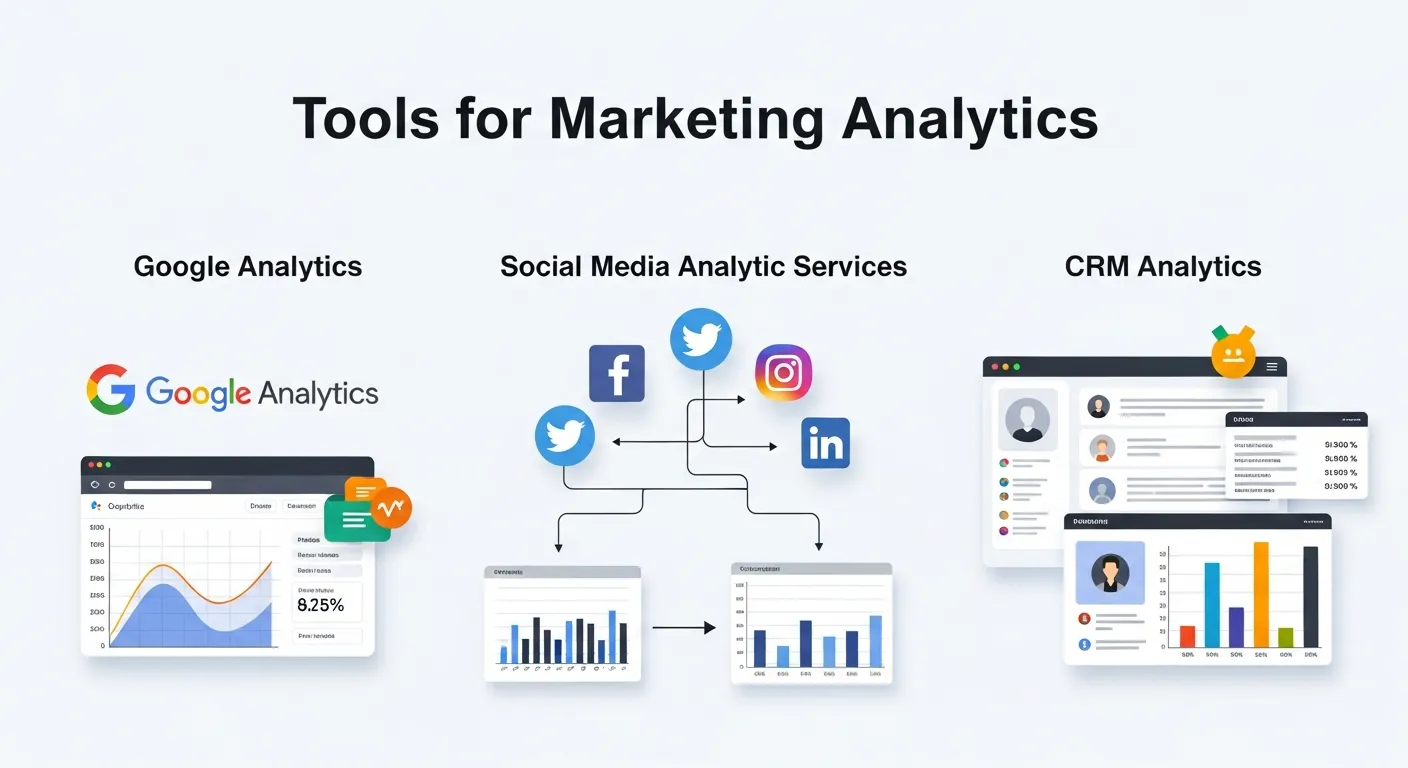
Some of the most valuable marketing analytics tools help track and analyze data. Here are a few of the strongest to have their place in your marketing stack:
Google Analytics
One of the most powerful tools Google Analytics offers is a deep dive into website metrics, such as the number of visitors, user habits, and session length. It is easy to handle and is applicable to a wide range of uses, which is why it is an industry standard.
Social Media Analytic Services
Tools like Facebook Insights, Instagram Analytics, and LinkedIn Analytics provide an in-depth look at how people engage with your social content. These are helpful measurement tools for metrics such as reach, impressions and engagement rates.
CRM Analytics
CRM Analytics, which focuses on analyzing the interactions between the customers and the company.
CRM solutions such as Salesforce, HubSpot or Zoho are indispensable for watching a customer through all stages of the lifecycle. Keep track of how you acquire customers, sales funnel stages, and engagement history all in one location.
Putting Together a Marketing Analytics Plan
Good strategy and execution is required to be effective in marketing analytics. Here is how you can create a data-driven strategy:
Set Goals and KPIs
Begin by setting out achievable goals. Do you desire more traffic for your site? Boost email open rates? And that is all you need to know to produce the right data.” Align your goals with KPIs for an easier monitoring.
Collect and Analyze Data
Use the things I have mentioned above for real-time stock market data. Trend and Correlation Spotlight the trends and correlations in the data. And remember: Raw data are just numbers unless they’re analyzed properly.
Build Reports and Optimize
Think about an ongoing reporting schedule to report progress to your most important stakeholders. Leverage dashboards or visualization tools to make data digestible. Then iterate. Good analytics turns insight into action for continual improvement.
Role of Marketing Analytics Metrics in Customer Segmentation
Marketing analytics metrics play a crucial role in effective customer segmentation. By analyzing behavioral, demographic, and transactional data, marketers can divide audiences into meaningful groups and deliver personalized messaging. Metrics such as purchase frequency, average order value, engagement rate, and customer lifetime value help identify high-value segments and growth opportunities. Instead of using one-size-fits-all campaigns, businesses can tailor offers based on real customer data. This approach improves relevance, increases engagement, and boosts conversions. When customer segmentation is driven by marketing analytics metrics, brands gain deeper insights into preferences and pain points, enabling smarter targeting across channels. Over time, data-backed segmentation leads to stronger relationships, higher retention, and improved marketing ROI.
Common Mistakes in Marketing Analytics Metrics (and How to Fix Them)
While marketing analytics metrics are powerful, many marketers struggle to extract meaningful insights due to common mistakes. Misinterpreting data or tracking the wrong metrics can lead to poor decisions and wasted budgets.
Avoiding these pitfalls helps businesses gain accurate insights and improve marketing performance consistently.
Common Mistakes Marketers Make
- Tracking too many metrics without clear goals
- Ignoring data quality and accuracy
- Focusing on vanity metrics instead of ROI-driven metrics
- Not using a centralized marketing analytics dashboard
- Failing to act on insights
Solutions to Improve Analytics Effectiveness
| Mistake | Impact | Recommended Fix |
|---|---|---|
| Too many metrics | Confusing insights | Focus on core KPIs |
| Vanity metrics | Misleading performance | Track revenue-linked metrics |
| Data silos | Incomplete analysis | Integrate analytics tools |
| Poor reporting | Weak decisions | Use dashboards & visuals |
| No optimization | Lost opportunities | Act on insights regularly |
By avoiding these mistakes, marketers can fully leverage marketing analytics metrics to drive smarter strategies and measurable results.
Case Studies – Some Marketing Analytics in Action

Looking for inspiration? Here’s a brief look at how some businesses have used marketing analytics to succeed:
Company X (Email Marketing)
Company X looked at their CTOR and found that higher-quality emails were more effective when sent mid-week. By tweaking send times, they increased CTOR by 20%.
Brand Y (Website Optimization)
An e-commerce site On an ecommerce site (I don’t know its actual service) used website visitors analytics to see that a product page was under-performing. Conversion rates went up 15% after the page redesign.
Solution Z (Social Media Expansion)
One SaaS brand saw a jump in Instagram CTR after they looked into what creative was working best. Simple changes to visuals resulted in 30% more ad clicks.
Future Directions of Marketing Analytics
Marketing analytics never waits for anybody. Here are a few trends to keep an eye on:
- Artificial Intelligence & Machine Learning: Technologies that use AI, such as predictive analytics, are gaining popularity, allowing companies to predict trends.
- Integrated Systems: More and more platforms are adding web, CRM, and social data — organizing it into a single view for sales.
- Regulations for Privacy Around Data Collection: Companies are evolving the way they think about data in the GDPR and other regulations, trying to be compliant and learn from that data.
- Toot our own horns about data-driven marketing reach and impact.
The era of marketing analytics has completely transformed the way companies interact with their consumers. Whether its optimizing your website for great performance or crafting social media content that resonates, if you analyze the right data, you can make smarter decisions and get better results.
Are you willing to have sexual relations? You can utilize the right tools and strategy and unleash the full glory of the power of marketing analytics to witness the growth that is simply not deniable.
Frequently Asked Questions (FAQs)
1. What are marketing analytics metrics?
Marketing analytics metrics are measurable data points used to evaluate marketing performance, such as traffic, engagement, conversions, and ROI.
2. Why are marketing analytics metrics important for marketers?
They help marketers understand what’s working, optimize campaigns, allocate budgets effectively, and make data-driven decisions.
3. What metrics should every marketer track?
Metrics every marketer should track include website traffic, conversion rates, customer acquisition cost, ROI, engagement rates, and retention metrics.
4. What is a marketing analytics dashboard?
A marketing analytics dashboard is a centralized visual tool that displays key marketing analytics metrics in real time for easy monitoring and reporting.
5. Which analytics metrics tools are commonly used?
Popular analytics metrics tools include Google Analytics, Tableau, Power BI, HubSpot, Salesforce, and social media analytics platforms.
6. How do marketing analytics metrics support campaign optimization?
They identify high-performing channels, reveal weak areas, and help marketers refine messaging, targeting, and timing for better results.
7. What role does social media analytics play in campaigns?
Social media analytics for campaigns tracks engagement, reach, CTR, and audience growth to improve content strategy and ad performance.
8. How often should marketing analytics metrics be reviewed?
Metrics should be reviewed weekly or monthly, depending on campaign goals, to ensure timely optimization and performance improvements.
9. Can small businesses benefit from marketing analytics metrics?
Yes. Even small businesses can use basic marketing analytics metrics to improve efficiency, reduce waste, and grow strategically.
10. How do marketing analytics metrics impact ROI?
By measuring performance accurately, marketers can focus on high-return activities, reduce ineffective spending, and maximize overall ROI.
 Rosemary Barker