

Powerful Marketing Analytics Unified customer data platforms eliminate silos by integrating all touchpoints into a single source of truth, enabling real-time analytics, personalization, improved marketing performance, governance, and customer experience in 2026 optimization.
In today’s Powerful Marketing Analytics landscape, businesses face an unprecedented volume of customer interactions across websites, mobile applications, social media channels, email campaigns, CRM systems, and offline touchpoints. Without a cohesive framework to unify this information, organizations encounter fragmented customer profiles, inconsistent targeting, and missed opportunities to deliver relevant, personalized experiences.
A Customer Data Platform (CDP) provides a centralized foundation that brings together data from disparate sources, resolves identities, and enables real-time analytics. By harnessing a unified Customer Data Platform, marketing teams gain a single source of truth for customer insights, empowering them to create timely, tailored campaigns and maximize return on investment. This article explores the critical challenges of siloed data, key features of a modern CDP, strategies for integrating diverse data streams, best practices for real-time processing, and governance principles for sustainable success.
Understanding Data Silos and Their Impact on Powerful Marketing Analytics

Marketing organizations often grapple with data silos that impede collaboration and stifle performance. When web analytics are stored separately from email campaign metrics, and offline sales figures reside in yet another system, teams struggle to piece together the complete customer journey. These silos result in duplicate records, conflicting segmentation, and ultimately, wasted ad spend. For example, disparate identifiers—such as an email address captured on a landing page and a device ID recorded in a mobile app—may not be linked, preventing a holistic view of each individual customer. In today’s highly competitive environment, delays in data processing can mean missed moments of engagement. By the time weekly batch reports arrive, customers may have moved on, rendering the insights obsolete for real-time personalization.
Resolving these issues requires an architectural shift toward continuous data ingestion, identity resolution, and enrichment pipelines. A centralized Customer Data Platform ingests events instantly, applies matching algorithms, and updates unified profiles in real time. This approach not only eliminates redundant records but also ensures that marketing teams can respond to customer behavior as it happens. In addition, a robust CDP supports dynamic segmentation, where audience definitions update automatically based on live attributes. Instead of waiting for nightly data loads, marketers see immediate changes—such as when a visitor abandons a cart or watches a product video—and can trigger tailored messages instantly.
Breaking free from data silos also fosters cross-departmental alignment. Sales, customer service, and product teams gain access to consistent, up-to-date customer profiles, enabling coordinated outreach and reducing friction. Moreover, unified data simplifies reporting and compliance: when all interactions funnel into one platform, it is easier to enforce privacy policies, manage consent, and demonstrate adherence to regulations such as GDPR or CCPA. In summary, dismantling data silos through a Customer Data Platform is a foundational step toward unlocking comprehensive insights and driving agile, personalized marketing strategies.
Key Features of a Customer Data Platform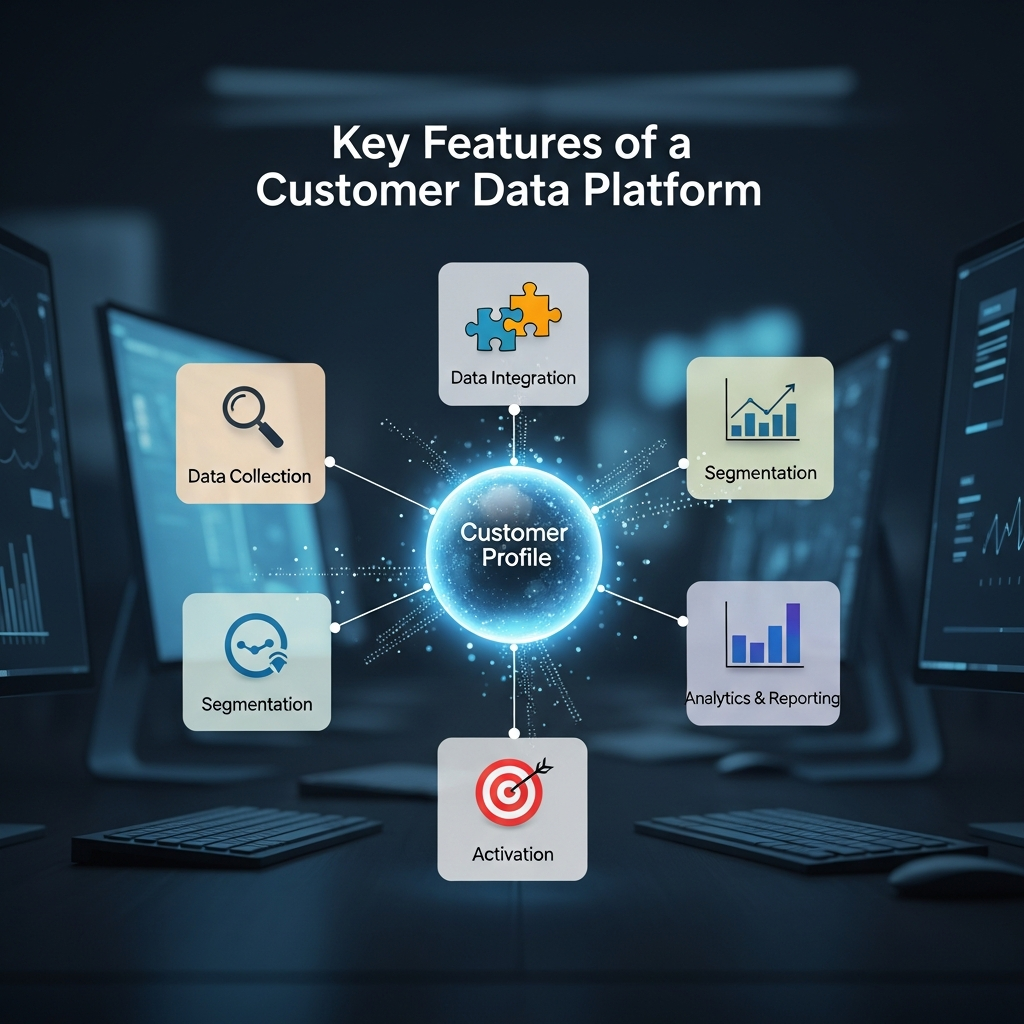
A modern Customer Data Platform offers a marketer-friendly interface and an array of capabilities designed for real-time activation and analytics. First and foremost, seamless data ingestion is essential. Whether capturing web page events, mobile app interactions, email opens, CRM updates, or point-of-sale transactions, a CDP should support APIs, event streaming, and batch uploads to ensure no data source is overlooked. For instance, integration with an e-commerce platform can feed purchase history and cart events directly into the CDP, enabling accurate lifetime value calculations.
Next is identity resolution. A CDP constructs an identity graph by merging deterministic matches (exact customer IDs, email addresses) with probabilistic techniques (behavioral patterns, device fingerprints). This graph eliminates duplicate records and links multiple identifiers—such as a customer’s desktop session, mobile device usage, and in-store visits—into a single, persistent profile. High-quality identity resolution enhances segmentation accuracy, ensures consistent personalization, and supports cross-device orchestration.
After identities are unified, data enrichment layers append demographic, firmographic, and behavioral attributes. A CDP might integrate third-party data provider insights or apply machine learning models to predict churn risk and lifetime value. Enrichment extends the depth of customer profiles, empowering marketers to create nuanced segments and deliver hyper-personalized offers. For advanced capabilities, many platforms include built-in analytics engines or connect seamlessly to solutions like Snowflake, Google Big Query, or Amazon Redshift for large-scale data processing.
Finally, real-time activation is what sets a CDP apart from traditional data warehouses. As soon as new data arrives, audiences and predictive scores update automatically. Marketers can immediately serve personalized content, display product recommendations, or adjust bid strategies in ad networks. This instantaneous response ensures that campaigns are relevant and timely, significantly improving engagement rates and ROI. To visualize and monitor KPIs, a CDP often integrates with business intelligence tools such as Tableau, Power BI, or Looker, delivering live dashboards that reflect campaign performance without delay.
Strategies for Integrating Diverse Data Sources

Successfully leveraging a Customer Data Platform hinges on broad connectivity and a systematic integration strategy. Begin by cataloging all customer touchpoints: identify online channels (websites, mobile apps, email), offline systems (point-of-sale terminals, call center logs), social media platforms, CRM databases, and third-party data providers. Prioritize critical sources that drive the greatest impact—transactional systems for purchase history, web analytics for engagement metrics, and CRM platforms for lead scoring. Establish robust data pipelines using APIs and event streams for real-time updates, while scheduling batch processes for less time-sensitive records.
When implementing API-based ingestion, ensure that endpoints are secure, rate-limited, and capable of handling peak traffic. For streaming architectures, consider solutions such as Apache Kafka or cloud-native event buses provided by major cloud vendors. These technologies allow you to collect events continuously, transform them on the fly, and load them into the CDP with minimal latency. For legacy or offline systems, batch uploads via encrypted file transfers and automated ETL routines can feed historical data into the platform.
Integration with social media and ad networks is equally important. By centralizing ad engagement metrics and audience insights, marketers can close the loop between paid media performance and downstream behavior. For example, linking Facebook or Google Ads data to unified customer profiles enables precise measurement of campaign ROI and facilitates remarketing to high-value audiences. Additionally, connecting email service providers and CRM systems ensures that subscription statuses, open rates, and lead attributes are reflected in real time, improving the accuracy of segmentation and campaign triggers.
For more complex scenarios—such as ingesting in-store transactions—leverage point-of-sale integrations that record purchases at the edge, then batch-sync or stream events to the CDP. This holistic approach yields a 360-degree customer view, as online and offline interactions converge in a single, unified repository. By adopting a flexible integration framework this year (2026), organizations can adapt quickly to new channels, maintain data consistency, and support advanced analytics across the entire customer lifecycle.

Implementing Governance, Compliance, and Best Practices
Deploying a Customer Data Platform successfully requires robust governance, clear objectives, and ongoing collaboration between marketing, IT, and analytics teams. Begin by defining measurable goals—such as reducing time-to-insight, improving personalization metrics, or increasing customer retention rates. Pilot key use cases, for instance, personalized email triggers based on abandoned cart events, before scaling across all channels. This iterative approach minimizes risk and demonstrates value early.
Data governance is paramount. Establish ownership for each data source, set quality standards, and implement validation rules to ensure accuracy. Define privacy policies that comply with regulations like the California Consumer Privacy Act (CCPA) and the General Data Protection Regulation (GDPR). Maintain an audit trail of data processing activities and secure consent records for first-party data usage. Embedding privacy-by-design principles ensures that customer preferences are respected, and trust is maintained.
To sustain adoption, prioritize ease-of-use. Select a CDP with intuitive interfaces that allow marketers to build segments, configure workflows, and launch campaigns without heavy reliance on IT. Provide training sessions and documentation to equip users with best practices. Foster cross-functional forums where teams share insights, refine matching rules, and optimize analytics models. Continuous iteration—refining identity resolution logic, expanding data sources, and adjusting segmentation criteria—drives incremental improvements over time.
Finally, measure success through key performance indicators. Track reductions in manual data wrangling hours, improvements in campaign lift (conversion and click-through rates), decreases in churn, and increases in revenue per customer. By linking these metrics back to your CDP initiative, stakeholders can appreciate the tangible benefits of unified customer data and support further investment in the platform.
In today’s data-driven environment, unifying customer information through a dedicated Customer Data Platform is no longer optional—it is essential. By breaking down silos, resolving identities, and enabling real-time analytics, organizations gain a comprehensive, up-to-date view of customer behavior. This single source of truth fuels dynamic personalization, predictive insights, and agile campaign execution, driving higher engagement and improved ROI. As privacy regulations tighten and customer expectations evolve, investing in a CDP that emphasizes governance and scalability will ensure long-term success. Start with clear objectives, integrate critical data sources, implement governance frameworks, and iterate continuously. In this year, a well-executed Customer Data Platform strategy can transform marketing operations and secure a competitive advantage for the years to come.