

Tracking the right metrics can make or break your marketing efforts. Modern marketing doesn’t run on guesswork; it requires data-backed decisions to outpace competitors and gain consumer trust. With so many metrics to choose from, marketers often face challenges in determining which ones truly matter for evaluating success.
This blog will guide you through the top five metrics every marketer should track, explain why they’re essential, and provide actionable tips to optimize each one. Whether you’re a digital marketing manager or a data-driven analyst, these insights will help you measure efforts effectively and maximize ROI. Plus, we’ll introduce how Analyze Nest’s cutting-edge tools can empower your marketing strategies.
Dive in, and discover how to harness the power of data to elevate your campaigns.
Why Tracking the Right Marketing Metrics Matters
Marketing metrics are more than just numbers on a dashboard—they are signals that guide strategic decisions. Tracking the right marketing metrics helps businesses understand what’s working, what’s wasting budget, and where opportunities exist. Without proper measurement, even creative campaigns can fail to deliver meaningful results.
By focusing on relevant marketing metrics, teams can align campaigns with business objectives, improve accountability, and make informed adjustments in real time. In a competitive digital landscape, data-driven marketers consistently outperform those relying on intuition alone.
How Marketing Metrics Drive Better ROI
Return on investment is the ultimate goal of any marketing initiative. Marketing metrics such as CAC, ROAS, and Conversion Rate directly reveal how efficiently resources are being used. When marketers track these metrics consistently, they can identify high-performing channels and eliminate underperforming ones.
Optimizing campaigns based on marketing metrics ensures that budgets are allocated wisely. Over time, this leads to improved profitability, reduced waste, and stronger overall campaign performance.
Leading vs Lagging Marketing Metrics
Not all marketing metrics serve the same purpose. They generally fall into two categories: leading and lagging metrics.
Leading metrics (like website traffic, engagement, and click-through rate) predict future performance.
Lagging metrics (like revenue, CLTV, and ROAS) measure outcomes after campaigns conclude.
A balanced analytics strategy uses both types of marketing metrics. Leading metrics help marketers adjust campaigns early, while lagging metrics confirm long-term success.
Customer Acquisition Cost (CAC)

What is CAC and Why Does It Matter?
Customer Acquisition Cost (CAC) measures how much it costs to acquire one customer. It is a critical indicator of how efficiently your marketing strategies attract customers while keeping expenses under control. High CAC may mean you’re overspending on campaigns that don’t yield sustainable customer growth, while a low CAC indicates a lean, effective strategy.
Formula to Calculate CAC
The formula is straightforward:
CAC = Total Marketing Costs / Number of New Customers Acquired
Example: If you spend $10,000 on marketing within a month and gain 50 customers during the same period, your CAC is $200.
How to Optimize CAC
- Streamline Campaign Targeting: Use detailed audience segmentation to ensure your ads reach a highly relevant audience.
- Leverage Retargeting: Retarget website visitors who didn’t convert the first time. This encourages conversions at lower costs.
- Refocus Spend: Invest in channels or campaigns with higher success rates, such as organic traffic or high-performing PPC ads.
Using Analyze Nest, you can break down CAC by channel, geography, and demographics, making it easier to identify cost-effective strategies.
Customer Lifetime Value (CLTV)
Why CLTV is Crucial for Long-Term Success
Customer Lifetime Value (CLTV) projects the total revenue you’ll earn from a single customer during their entire relationship with your business. A high CLTV ensures long-term profitability even if CAC is relatively high. It’s the go-to metric for subscription businesses, e-commerce, and B2B.
Formula for CLTV
CLTV = (Average Purchase Value) x (Purchase Frequency) x (Customer Lifespan)
Example: If an average customer spends $100 per purchase, buys twice a year, and remains loyal for five years, your CLTV is $1,000.
Strategies to Boost CLTV
- Strengthen Loyalty Programs: Provide incentives for repeat purchases through exclusive offers or membership perks.
- Focus on Upselling & Cross-Selling: Offer complementary or upgraded products to increase purchase value.
- Personalize Customer Experiences: Use email campaigns and recommendations tailored to individual preferences.
Analyze Nest offers detailed CLTV projections that help you pinpoint where customer relationships thrive and where they need improvement.
Conversion Rate (CR)

What is Conversion Rate?
Conversion Rate measures the percentage of users who complete a desired action, such as signing up for a newsletter, making a purchase, or downloading an eBook. High conversion rates signal effective messaging, solid user experience, and relevance between your offers and audience needs.
Formula for Conversion Rate
CR = (Number of Conversions / Total Visitors) x 100
Example: If 1,000 people visit your landing page in a week and 50 fill out the form, your CR is 5%.
Tips to Improve Your CR
- Optimize Landing Pages: Use clear CTAs (calls to action), compelling visuals, and minimal distractions to improve usability.
- A/B Testing: Experiment with headlines, buttons, and designs to see what resonates with your audience.
- Speed Up Load Time: Research shows a 1-second delay in page load time can reduce conversions by 7%. Optimize your website’s performance.
Tracking CR via Analyze Nest helps you identify which funnels work best and where drop-offs happen.
Return on Ad Spend (ROAS)

Why ROAS is a Must for Ad Campaigns
Return on Ad Spend (ROAS) evaluates the revenue earned for every dollar spent on advertising. It is invaluable for measuring the effectiveness of marketing campaigns across platforms like Google Ads, Facebook, or Instagram.
Formula for ROAS
ROAS = (Revenue from Ads / Cost of Ads) x 100
Example: If you generate $5,000 in revenue from a $1,000 ad campaign, your ROAS is 5x, or 500%.
How to Optimize ROAS
- Use Targeted Keywords: Research long-tail and intent-driven keywords that are more likely to convert.
- Scale High-Performing Campaigns: Focus your budget on ads that consistently drive results to maximize gains.
- Monitor Metrics Regularly: Track costs and make adjustments using analytics tools to keep ad performance aligned with ROI goals.
Analyze Nest simplifies ROAS tracking with real-time data and insights for each marketing platform, enabling smarter budget allocation.
Website Traffic
Importance of Monitoring Website Traffic
Website traffic reflects the reach and visibility of your business. Tracking visitor trends, engagement, and behavior enables you to understand how well your strategy generates interest and guides users through the sales funnel.
Key Traffic Metrics to Track
- Sessions: Measures the number of visits to your website.
- Bounce Rate: Percentage of visitors leaving the site without taking any action.
- Time on Page: Average time users spend interacting with your content.
Strategies to Drive Website Traffic
- SEO: Optimize for keywords, meta descriptions, and backlinks to attract organic traffic.
- Content Marketing: Regularly produce relevant and valuable blog posts, videos, and infographics targeting your audience’s interests.
- Social Media Campaigns: Share your website content consistently on platforms like LinkedIn, Twitter, and Instagram for broader reach.
Analyze Nest tracks every aspect of your website performance, offering actionable insights for growth.
How to Choose the Right Marketing Metrics for Your Business
The right marketing metrics depend on your business model, goals, and customer journey. For example, SaaS businesses prioritize CLTV and churn rate, while e-commerce brands focus heavily on conversion rate and ROAS.
Start by defining your objectives—brand awareness, lead generation, or sales growth—then select marketing metrics that directly support those goals. This focused approach ensures data stays actionable rather than overwhelming.
Common Mistakes Marketers Make When Tracking Metrics
One common mistake is tracking too many marketing metrics without clear goals. This creates confusion rather than clarity. Another frequent issue is focusing only on vanity metrics—such as likes or impressions—without tying them to conversions or revenue.
Marketers should also avoid analyzing metrics in isolation. Marketing metrics are most powerful when viewed together, revealing patterns and cause-effect relationships that drive smarter decisions.
The Role of Marketing Analytics Tools in Metric Tracking
Manually tracking marketing metrics is inefficient and error-prone. Analytics tools automate data collection, visualization, and reporting, giving marketers instant access to insights across channels.
Platforms like Analyze Nest centralize marketing metrics such as CAC, CLTV, traffic, and ROAS into a single dashboard. This eliminates guesswork and allows teams to focus on strategy rather than spreadsheets.
Turning Marketing Metrics into Actionable Insights
Tracking marketing metrics alone isn’t enough—action is what drives results. Metrics should inform testing, optimization, and strategic shifts. For example, a rising CAC may signal the need to refine targeting or creative messaging.
Regular reviews of marketing metrics help teams identify trends, test improvements, and scale what works. Insight-driven action is the bridge between data and growth.
Future Trends in Marketing Metrics and Measurement
As privacy regulations evolve and third-party cookies decline, marketing metrics are shifting toward first-party data and predictive analytics. Metrics like customer lifetime value and engagement quality will become even more critical.
Advanced tools powered by AI and machine learning will help marketers forecast performance, personalize campaigns, and measure impact more accurately. Staying ahead of these trends ensures long-term success in data-driven marketing.
Marketing Metrics by Funnel Stage
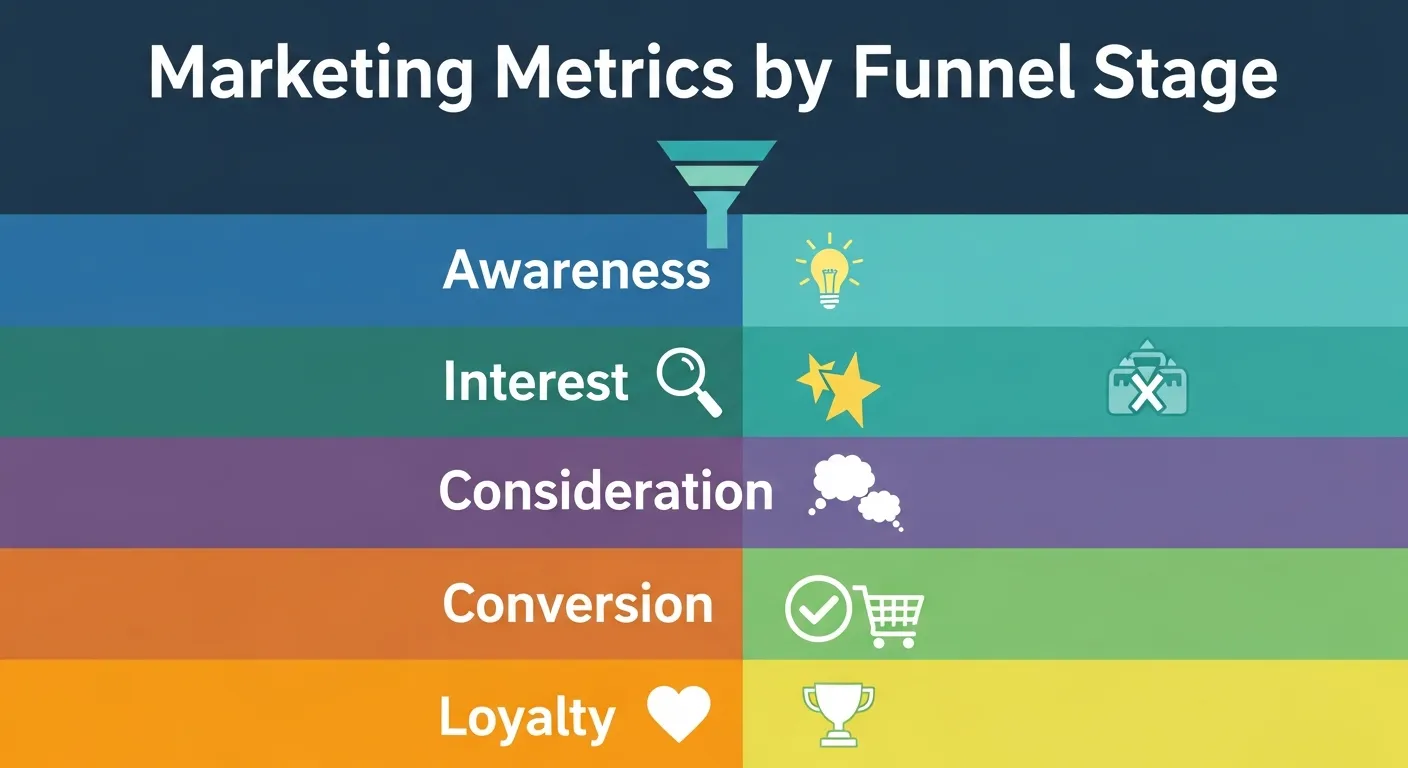
Not all marketing metrics apply equally at every stage of the customer journey. Mapping marketing metrics to funnel stages helps marketers measure the right performance signals at the right time. When metrics are aligned with awareness, consideration, and conversion stages, optimization becomes more precise and actionable.
By tracking stage-specific marketing metrics, teams can identify bottlenecks, improve customer movement through the funnel, and allocate resources more effectively.
Key Benefits of Funnel-Based Metric Tracking
- Improves visibility into where prospects drop off
- Helps align marketing and sales teams around shared goals
- Enables targeted optimization instead of broad assumptions
- Supports better forecasting and campaign planning
Marketing Metrics by Funnel Stage
| Funnel Stage | Primary Marketing Metrics | Purpose |
|---|---|---|
| Awareness | Website Traffic, Reach, Impressions | Measure brand visibility and audience growth |
| Engagement | Click-Through Rate (CTR), Time on Page, Bounce Rate | Evaluate interest and content relevance |
| Conversion | Conversion Rate (CR), CAC, ROAS | Measure campaign efficiency and cost impact |
| Retention | CLTV, Repeat Purchase Rate, Engagement Rate | Track long-term value and loyalty |
Using analytics dashboard tools like Analyze Nest, marketers can visualize these funnel-stage metrics in one place, making it easier to optimize each step of the customer journey.
How to Build a Marketing Metrics Dashboard That Works
A marketing metrics dashboard turns raw data into clear, decision-ready insights. Without a well-structured dashboard, even the most important marketing metrics can become overwhelming and underutilized. The goal is to highlight what matters most, not everything that’s available.
An effective dashboard helps marketers monitor performance, detect issues early, and communicate results clearly to stakeholders.
Essential Elements of a High-Impact Marketing Metrics Dashboard
- Goal-aligned metrics: Only include metrics tied to business objectives
- Real-time updates: Enable faster decision-making and optimization
- Cross-channel visibility: Combine paid, organic, and social data
- Clear visual hierarchy: Highlight KPIs first, supporting metrics second
Common Dashboard Metrics by Category
| Category | Marketing Metrics Included | Why It Matters |
|---|---|---|
| Acquisition | CAC, Traffic Sources, CTR | Shows how efficiently users are acquired |
| Performance | Conversion Rate, ROAS | Measures campaign effectiveness |
| Engagement | Time on Page, Bounce Rate | Indicates content and UX quality |
| Revenue | CLTV, Revenue by Channel | Connects marketing to business outcomes |
Marketing analytics metrics tools like Analyze Nest simplify dashboard creation by automatically syncing data, generating visual reports, and supporting smarter, faster decisions.
Making Data-Driven Marketing Decisions
By tracking these five metrics—CAC, CLTV, CR, ROAS, and Website Traffic—you’ll gain unparalleled clarity into what works and what doesn’t in your marketing efforts. They help guide smarter budgeting, better campaign strategies, and higher ROI.
The key to success lies in having the right tools to analyze and optimize these metrics. That’s where Analyze Nest comes in. Our all-in-one marketing analytics platform provides actionable insights tailored for marketers at every level.
Why guess when you can track, analyze, and grow with confidence?
Frequently Asked Questions (FAQs)
1. What are marketing metrics?
Marketing metrics are measurable data points used to evaluate the performance of marketing campaigns, channels, and strategies against business goals.
2. Why are marketing metrics important for businesses?
Marketing metrics help businesses make data-driven decisions, optimize budgets, improve ROI, and understand customer behavior more accurately.
3. What are the most important marketing metrics to track?
Key marketing metrics include Customer Acquisition Cost (CAC), Customer Lifetime Value (CLTV), Conversion Rate (CR), Return on Ad Spend (ROAS), and Website Traffic.
4. How do marketing metrics improve ROI?
By tracking marketing metrics, marketers can identify high-performing campaigns, eliminate wasteful spend, and focus resources on strategies that deliver the best returns.
5. What is the difference between marketing metrics and KPIs?
Marketing metrics measure performance, while KPIs are selected metrics tied directly to strategic business objectives and success benchmarks.
6. Which marketing metrics are best for social media campaigns?
For social media analytics for campaign performance, key metrics include engagement rate, reach, click-through rate, conversions, and ROAS.
7. How often should marketing metrics be reviewed?
Most marketing metrics should be reviewed weekly or monthly, while high-impact campaigns may require real-time or daily monitoring.
8. What tools help track marketing metrics effectively?
Analytics dashboard tools and marketing analytics metrics tools like Analyze Nest help centralize, visualize, and analyze data across channels.
9. Can small businesses benefit from marketing analytics tools?
Yes, small businesses can master marketing analytics using affordable tools to track essential marketing metrics and compete more effectively.
10. How do analytics dashboards support data-driven marketing?
Analytics dashboards combine multiple marketing metrics into a single view, helping marketers spot trends, gain insights faster, and make smarter decisions.
 Rosemary Barker